
Mental Hygiene
The practice of cleansing and maintaining the mind so meaning can be shaped consciously; rather than shaping your life from the deep.
Most people are taught physical hygiene. Almost no one is taught how to tend to the mind interpreting their life. Mental hygiene is where that practice begins.

Contents
-
What Is Mental Hygiene?
-
Why Mental Hygiene Matters
-
How Mental Hygiene Works
-
Why Mental Hygiene Matters Now
-
Real-World Examples
-
Misconceptions
-
Where Mental Hygiene Leads
-
Frequently Asked Questions
What Is Mental Hygiene?
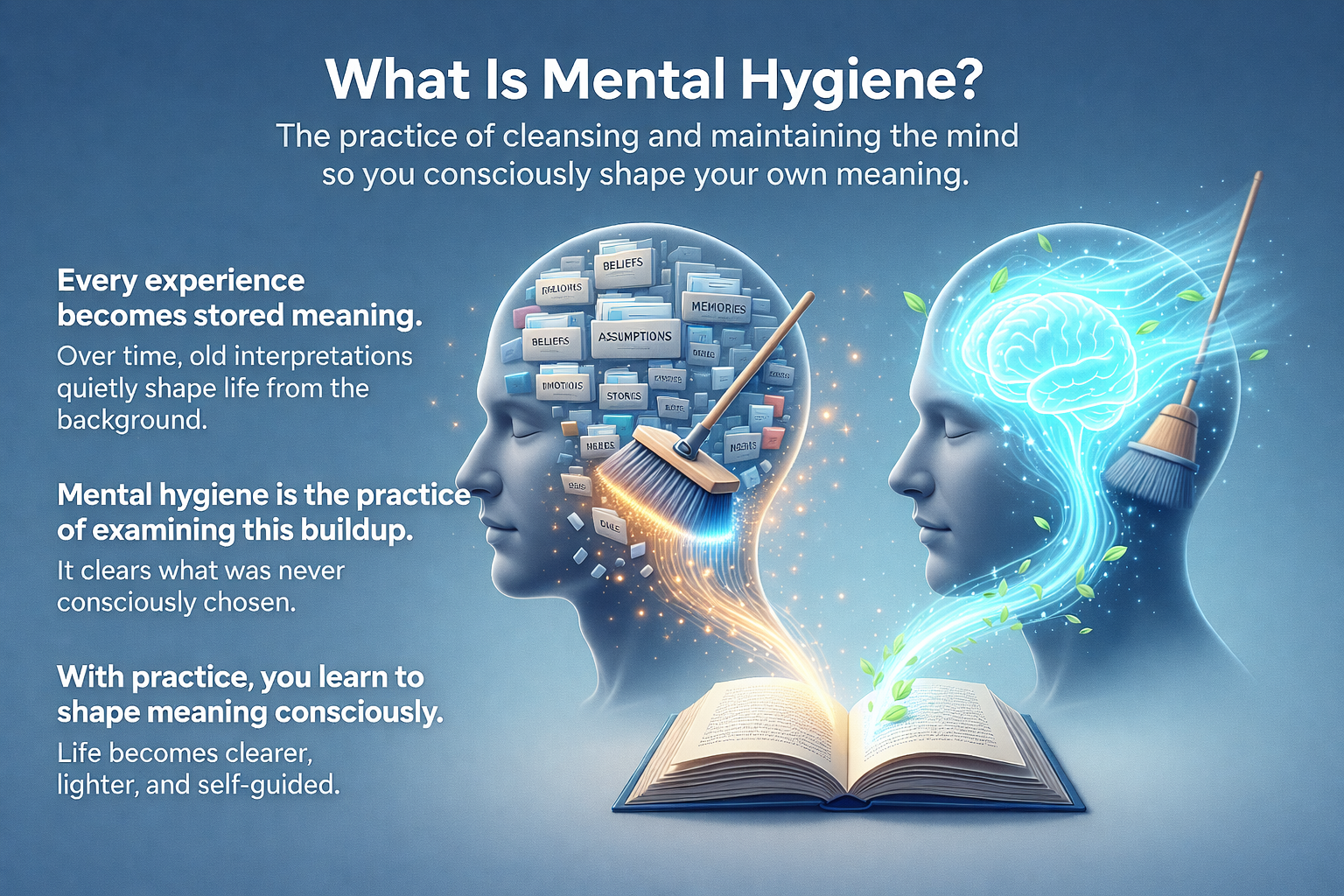
Mental hygiene is the practice of cleansing and maintaining the mind so meaning can be shaped consciously; rather than shaping your life from the deep.
Every experience passes through interpretation. The ability to create, automate, and navigate meaning is one of our defining characteristics as a species.
Simply put — we hold on to stuff.
Mental hygiene is the practice of examining that buildup so the mind does not quietly run on meanings we never consciously chose. Over time this becomes more than clearing accumulation. It becomes the ongoing discipline of refining the interpretations shaping how you experience and respond to life.
Cognitive Flexibility, and the Gift of the DMN
All day long, the mind generates patterns of meaning. Smatterings of matterings. Many of those patterns get reinforced through habitual, self-referential processing associated with what neuroscientists call the Default Mode Network, or DMN. The DMN is most active during internally focused thought, such as mind-wandering, self-reflection, remembering the past, and imagining the future. Cognitive flexibility, also called cognitive shifting, is your brain’s ability to adapt to new, changing, or unexpected conditions. That is why inner excavation matters: it helps you spot the obsolete assumptions and habitual meanings running in the background of your system. Without conscious reflection and updating, old patterns can keep shaping your experience long after they stop serving you.
Read more about cognitive flexibility.
Why Mental Hygiene Matters
Most people are taught physical hygiene. Very few are taught how to tend to the mind.
That matters because the mind automates meaning. Left unattended, it keeps generating experience through old patterns, unresolved charges, and inherited interpretations. This is why suffering repeats — not because something is wrong with you, but because the meanings driving behavior have never been examined.
The mind is not the problem. The meanings it has automated are.
Human beings are capable of far more than repetition running from below conscious awareness. But that potential only becomes accessible when the meanings shaping perception are consciously engaged.
Without mental hygiene, limiting patterns repeat. With it, meaning becomes something you participate in — rather than something that runs you.
How Mental Hygiene Works
The mind is constantly translating experience into meaning.
Something happens. The mind interprets it. That interpretation shapes emotion, perception, and behavior. Repeated often enough, those meanings organize into patterns — and those patterns begin to organize a life.
When meaning is not examined, the mind defaults to familiar interpretations. When it is tended, those patterns can be seen, recalibrated, and consciously directed.
Mental hygiene begins by noticing the buildup. It deepens through examining the meanings attached to reactions. Over time, it becomes an active discipline of refining the quality of meaning we live from.
This is not just maintenance. It is training.

Why Mental Hygiene Matters Now
"The illiterate of the 21st century will not be those who cannot read and write, but those who cannot learn, unlearn, and relearn."
— Alvin Toffler, Futureshock
The Environment
- ~13 average hours per day consuming media
- 150+ phone checks per day, per person
- ~0.4 zettabytes new information generated daily by humans
- ~75% of knowledge workers now use AI tools
The Impact on the Mind
- 40 seconds average sustained attention on a single task (down from ~2.5 minutes a decade ago)
- Up to 40% productivity reduction from chronic multitasking
- 23 minutes for the brain to fully recover focus after a single interruption
- High social media use is linked to declining attention and impulse control
The Opportunity
- Attention and cognitive clarity are trainable
- Strategic contemplation and journaling improve focus, emotional regulation, and decision-making
- The person who tends their mind holds a compounding advantage over one who does not
Mental hygiene is becoming one of the most essential skills of the modern age.
Real World Examples of Mental Hygiene
In Relationships
You begin to notice when your response to someone is being shaped by older meaning; not by the person in front of you. The reaction is real. But the source is not what it appears. Something is being triggered that predates this conversation. Mental hygiene is what lets you see the difference.
At Work
You learn to separate genuine feedback from the story layered onto it by prior experiences of failure, visibility, or worth. The critique is about the work. The charge is about something older. Noticing that distinction changes how you respond — and what you do next.
In Personal Growth
You start to see when you are not blocked by a lack of desire or ability, but by meanings that quietly organize hesitation, self-protection, or sabotage at the threshold of something new. The door is open. The meaning is what keeps you from walking through.
At a Larger Scale
As the practice matures, you begin to move from reacting through inherited interpretation to creating with greater consciousness and intent. This is where mental hygiene stops being about damage control and becomes something more like authorship.
At a higher level, it helps human beings evolve from reacting through inherited interpretation to creating with greater consciousness and intent.
Misconceptions About Mental Hygiene
It is not positive thinking
Awareness alone is not the practice
This is not only about preventing suffering
This is not a war against the self
Where Mental Hygiene Leads
Mental hygiene begins by helping you notice the meanings shaping your life. As that practice deepens, something else becomes visible — some meanings carry a charge that the present moment alone cannot explain. Your reaction is disproportionate. The pattern is too familiar. Something older is operating.
That is where the hidden material of the mind begins to reveal itself.
This leads naturally into shadow work. Because awareness alone is not enough. Tending the surface does not reach what is driving from beneath it. Shadow work is the practice of engaging that material directly: the meanings that have gone underground and are quietly organizing your experience of life from the deep.
Mental hygiene tends the mind. Shadow work uncovers what is shaping it.
Together, they begin moving you toward something more than symptom management
— toward conscious authorship of meaning itself.
Learn about Shadow Work
Frequently Asked Questions
What is the difference between mental hygiene and mental health?
Is mental hygiene the same as mindfulness?
What are examples of mental hygiene practices?
Why do patterns keep repeating even after therapy or self-help work?
Can you practice mental hygiene on your own?

Shadow Work
Tending to your meaningful resistance

Depth Work
Shadow work is only the beginning
Turning Within
Reclaiming authorship over meaning

The Construct
The structural model of experience